Bright Hill Drive · District 20 · Independent guide
Pick a stack that stays cool after 3 pm.
In Singapore the harsh sun comes in the afternoon, from the west. Across Thomson Reserve's 55 stacks, afternoon sun on the windows ranges from almost none to about 6 hours a day. This guide shows you which is which before you pick a unit.
Site plan
86 facilities across three clubs
Pick a club to see its facilities light up, or play the tour. Tap any number on the plan or in the list to find it.
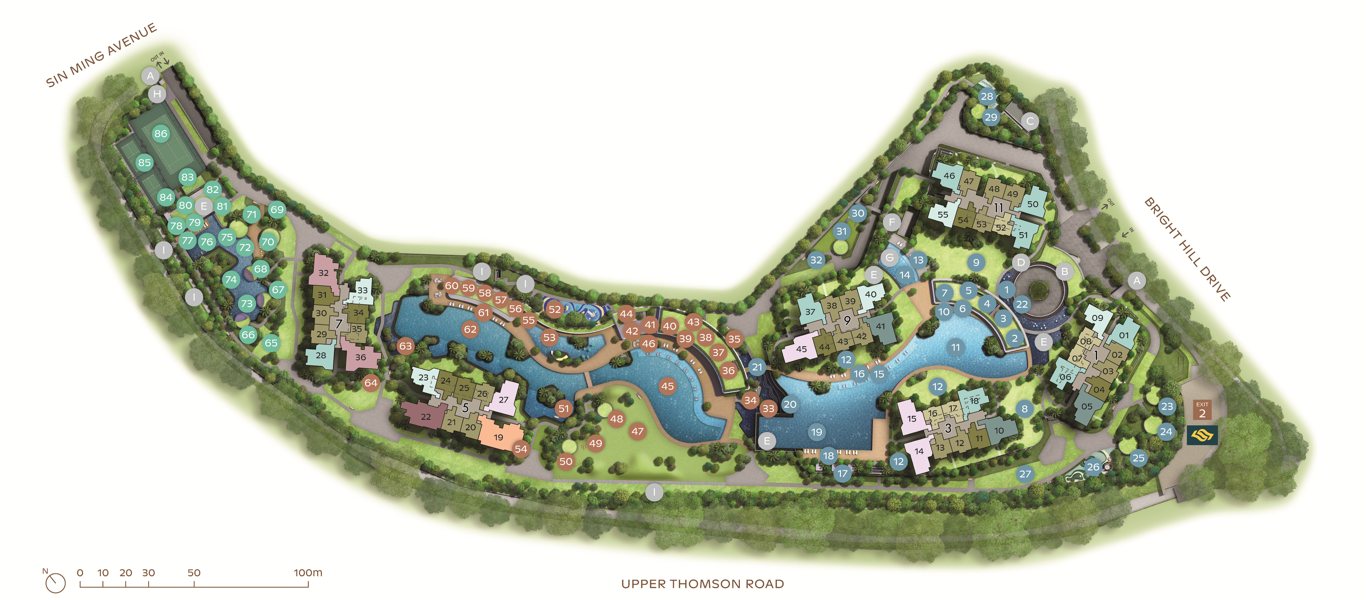
Site plan and facility list from the developer's brochure. Facilities may change.
Stack by stack
Where the afternoon sun lands
Hours of direct sun on each stack's windows, averaged over all floors and over three dates: 21 June, 22 September and 21 December. Morning sun is gentle; afternoon sun is what heats a home.
Coolest stacks
Least afternoon sun, most comfortable in the evening
| Stack | Block | Unit type | Windows face | Morning | Afternoon |
|---|
Most afternoon sun
Bright, but expect heat after 3 pm
| Stack | Block | Unit type | Afternoon |
|---|
By block
Average across every stack in the block
| Block | Storeys | Stacks | Morning | Afternoon | Coolest stack |
|---|
Based on a simplified 3D model placed on the official site plan. Shading counts the six towers and every surrounding building within 650 m (OneMap 3D building models, SLA), not trees or terrain. Check the floor plan for each unit before deciding.
Analyse any stack, any hour
Pick a date and time, play the day, and tap a unit to see its morning and afternoon sun floor by floor.
Wind and ventilation
Which stacks catch the monsoon breeze
Singapore's breeze follows two monsoons. A unit whose windows face the wind, with nothing tall upwind, stays airier. Corner units with windows on two sides can also draw air through.
Forecast at Bright Hill Drive
Next 7 days
Dec to early Mar
Northeast monsoon
Wind from the north to northeast, about 2.8 m/s in Jan–Feb and stronger in surges. The steadiest breeze of the year.
↑ blows toward the south-southwest
Jun to Sep
Southwest monsoon
Wind from the southeast to south, about 2.0–2.5 m/s. Lighter, often with hazier, warmer days.
↑ blows toward the north-northwest
Apr–May, Oct–Nov
Inter-monsoon
Light and variable winds with land and sea breezes. Window direction matters less in these months.
Breeziest stacks
Breeze score 0–100, averaged over all floors
| Stack | Block | Unit type | Windows face | NE | SW | Breeze |
|---|
Cool and breezy
Little afternoon sun (1.5 h or less) and a breeze score of 35 or more
| Stack | Unit type | Afternoon | Breeze |
|---|
The breeze score is a rule of thumb, not a wind simulation. For each monsoon it checks how squarely the windows face the wind, how far the wind travels before reaching the windows (towers and buildings close upwind lower the score), and the floor height. "Breeze" averages both monsoons and adds a small bonus for corner units that can cross-ventilate. It ignores trees, private buildings, terrain and wind channelled between towers. Monsoon months, directions and speeds are from the Meteorological Service Singapore.
Unit types by stack
What each stack is, and how big
Each stack is one unit type from floor to roof. Colours follow the developer's unit distribution chart, and the small bar shows afternoon sun. Tap any stack to see its floor plan.
| Unit type | Size | Units | Price | Stacks |
|---|
Floor plans: pros and cons
Every layout type, read from the developer's plans. Open one to see what works and what to watch for.
Some stacks have a variant (marked p in the developer's chart) on their lowest floor. Sizes are strata areas from the unit chart; confirm with final floor plans.
Location
Upper Thomson, next to MacRitchie
- Address
- Bright Hill Drive, Singapore (District 20)
- Developers
- UOL, Singapore Land Group and CapitaLand
- Site area
- ~540,300 sq ft
- MRT
- Upper Thomson (TE8), about 260–380 m
Bright Hill (TE7 / future CR13), about 710–760 m - Schools
- Ai Tong School, about 500 m
Catholic High, CHIJ St. Nicholas Girls', Ang Mo Kio Primary within 2 km - Nature
- Beside MacRitchie Reservoir and the Central Catchment Nature Reserve
Distances vary slightly between published sources and are approximate.